
I’ve made a gadget that can track our gliders at my gliding club. It’s still in test mode – I need to install it with a good antenna at the clubhouse in Camden Airport.
It tracks the gliders by listening to their FLARM signals. Flarm – flight alarm – is fitted to all our gliders and tow planes. It consists of a low-power transmitter and receiver and a GPS that sends position, speed and track to other Flarm units. There’s a small display in the glider that shows the direction of any conflicting traffic and its height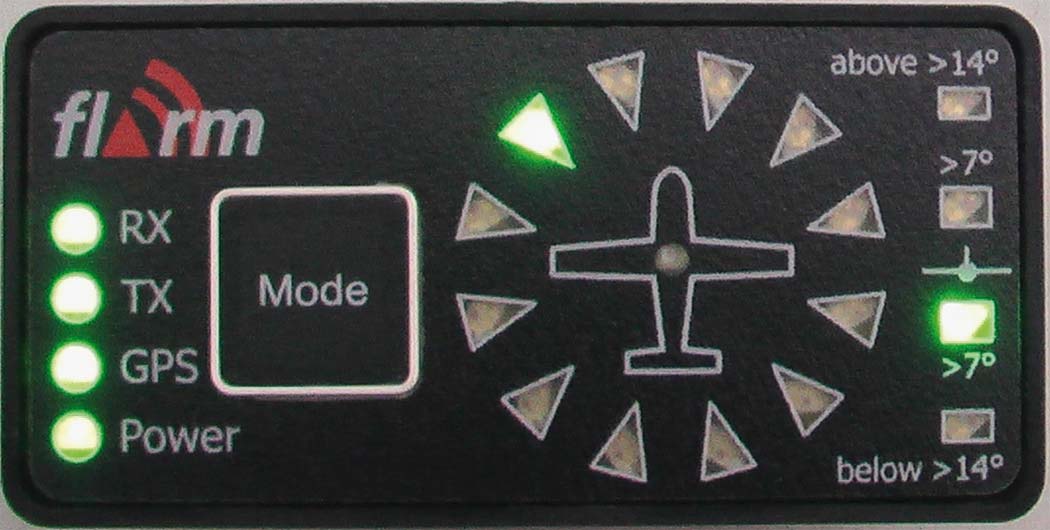 relative to you. It’s very useful – bumping into another glider could ruin your day.
So if you can receive and decode those Flarm signals on the ground, you can show them on a map display and keep an eye on your gliders. You can also capture times of takeoff and landing automatically, instead of having to have someone write them down on a paper logbook.
Luckily, some clever people have written software for such a thing. So I have built a unit consisting of a cheap ($15) dongle originally designed to send TV signals into a laptop plus a Raspberry Pi mini-computer. I also built a coaxial collinear antenna and a power-over-ethernet setup – this is so the receiver can be kept close to the antenna and limit losses in the antenna cable. 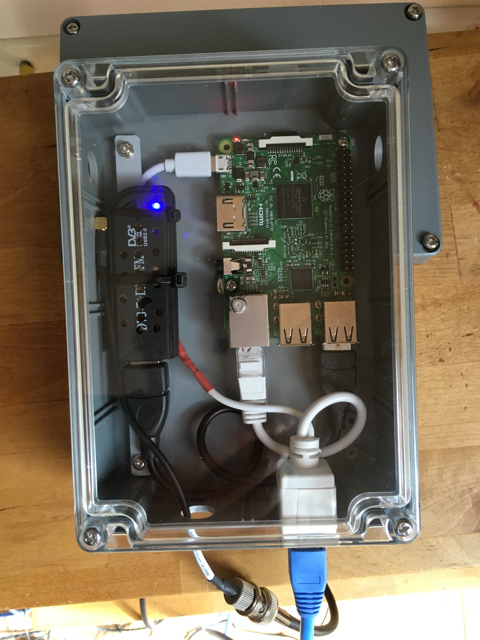
I’ve put it in a neat box with a clear lid so I can see the lights flashing that show it’s all working.
It took a while to set up as the software is based on the European Flarm frequency of 868MHz but Australian Flarms use 921 MHz. Luckily, the guy who wrote the software came to my aid via email – he’s Pawel Jalocha, a Postdoctoral Research Assistant at Oxford University. He’s done lots of work on transmitting radio data in packets and decoding weak signals.
So the project needed my skills at planning (moderate) soldering (excellent), drilling, gluing (good) crimping connectors (good) and software code writing (execrable). But I’ve learned a fair bit of command-line Linux to help me through it all. I log into the Raspberry Pi using ssh on my Mac and issue commands such as sudo service rtlsdr-ogn status or telnet localhost 50000 or sudo nano rtlsdr-ogn.conf. Fun eh?
The project is called the Open Glider Network and the software is open source. There are lots of receivers in Europe and you can see live glider movements there during the European daytime on their webpage.
The next step is to install the antenna and receiver at the gliding clubhouse. I need someone to go up a ladder to do that.
In the meantime, I’m testing at home and you can see my receiver when it is switched on. The co-ordinates are for Camden so it shows the receiver at Camden even when it is a at home (confusing eh!).
A work in progress – fingers crossed that it does the job at Camden.





What a great idea! I followed your link and I have just watched a flight in the UK near me.
I am sure your set-up is going to be an asset to the Camden club, so I imagine you won’t have too much trouble getting someone up that ladder !
I look forward to seeing a little marker with HJS zooming around Camden in the not too distant future.